Welcome to my blog, my name is Daria Morgendorffer and I am a high school senior at the elusive Lawndale High. My intention for the upcoming blog posts is for my AP Government and Politics Class in which we break down the political system in the United States. In this initial post I will be discussing my political ideology, how I found my specific political ideology was a through a survey provided below. Now the results you get may vary and hopefully you won’t be shocked or surprised by them.
According to the Pew Research Center I am a Solid Liberal. But I already figured that this was the case for me. Solid Liberals for those who have been completely oblivious to any prior knowledge of what the political caste system is, a solid liberal is someone who is all for progress whether that be in economic or social progress they are people who are able to adopt a “equality over equity.” Something a solid liberal would stand behind would be the Washington Referendum 88, Vote on I-1000 Affirmative Action Measure (2019) which has to do with affirmative action and allowing minorities the equal opportunities as those who might not be as qualified as others. This is something that is fairly important to liberals.
What is a New Era Enterpriser? Where do they stand in the political hierarchy?
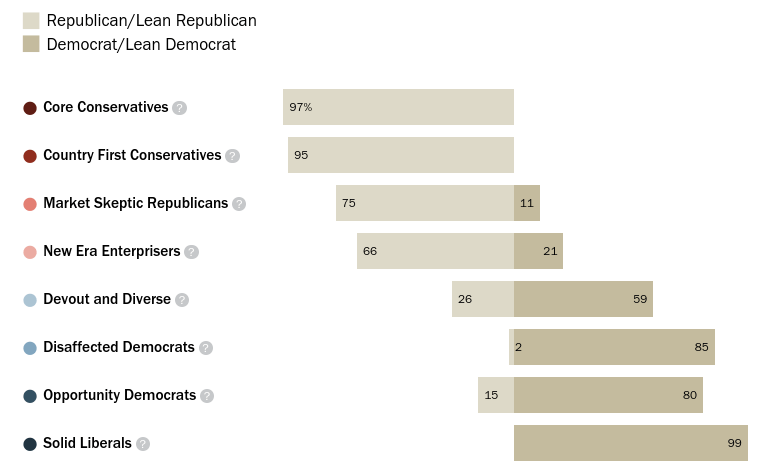
One Political Ideology that differs from mine is the the New Era Enterprisers, they gravitate towards policies and ideas that promote the state of the nation and are for promoting a younger and a less overwhelmingly white background. But in comparison to Solid liberals they are more in favor of the Republican party than the solid liberal.
This Graph Illustrates which political party Solid Liberals favor in comparison with New Era Enterprisers.
On the topic of Affirmative action, Solid Liberals believe that affirmative action is a good way to promote equal opportunity for people of all races and all genders giving them the access to things they might not otherwise be able to without it. When looking for comparison between the two, I found that the Majority of New Era Enterprisers are in favor of affirmative action but there is a significant about you oppose it as well. When looking at Solid Liberals we can conclude that they are closer to 100% with 95% of them believing its a good thing, rather than New Era Enterprisers who believe that affirmative action is a good thing 67% of them believe its a good thing while 23% of believe that is a bad thing which is much higher in comparison to the measly 5% the Solid Liberals have. This shows us that While although they believe its a good thing for the most part there is still some disbelieve dispersed throughout the party.
“A political party is an organized body of like-minded people who work to elect candidates for public office who represent their values on matters of policy. In the U.S., home to a strong two-party system, the major political parties are the Republicans and the Democrats.”
In today’s post we will be discussing what a successful economy looks like, in my opinion a successful economy would be one that’s citizens make more than the average cost of living so that gap between rich and poor is narrower than previously seen before. This particular aspect directly correlates with the nations GDP
I’m going to be concentrating on political parties and their effect on the market, particularly, the Democratic Party opposed to the Republican Party. However before we concentrate on that, we need to establish what is considered as a “thriving economy”. To my understanding, a successful market suggests that there is uninterrupted growth in various aspects, such as GDP (Gross Domestic Product, used to estimate the dollar value of all goods and services in a country), jobs, and other possibilities.
In the graph above from the United States Joint Economic Committee (JEC), it can undoubtedly be observed that the GDP of the nation has improved while under a Democratic president. Democrats have driven an average growth GDP growth of 3.9% while Republicans have only led towards an average growth GDP growth of 2.5%. This means that under Democratic presidents, the value of goods and services in the United States has seen a more substantial overall growth compared to Republican presidents. The distinction between Democratic presidents and Republican presidents can be further developed when observing that Truman had an average GDP growth of 4.9% and Kennedy/Johnson had 5.3% while the two highest average GDP growth for Republican presidents were Reagan with 3.4% and both Nixon and Ford ending with 2.7%
Another fundamental detail to notice is that even while going through a recession (phase of economic decline), Obama nevertheless maintained to produce a larger average GDP growth of 2.0% while W. Bush only had 1.6%. But it is also crucial to point out that the Democratic leaders in GDP growth also had events that contributed to the growth, such as the creation and increase in popularity of the internet and military duty. Military engagement presents understanding when considering that Kennedy/Johnson and Nixon/Ford were all presidents throughout the Vietnam War, nonetheless, this also leads to a deviation where W. Bush became entangled in Afganistan and only had a GDP growth of 1.6%.
It is also necessary to recognize that Congress also has a significant position in the general economy. Congress is in command of passing bills that consist of taxes and the economy. If one president doesn’t work with Congress to pass bills that would improve the economy, then there would be no shift in GDP growth or decrease. The whole concept of a thriving economy is incredibly nuanced and reliant on popular events; this makes it extremely hard to tell what actually has the biggest impact on the economy.
From my standpoint, one of the most impactful factions that impact elections is political parties. Political parties have a huge influence on the American public’s views because many Americans are affiliated with one of the two major political parties, and these simple party loyalties affect their actions in terms of voting. Americans view politics through the views of their party, and that ends up having a tremendous impact on the decisions of people if they vote.
In my belief, the most consequential impression on national elections in America is due to political parties. Especially with the political polarization of the American people today. Political parties have been the basis for the divide in beliefs and ideology across all of America. Political parties hold a huge influence on the beliefs of the American public since “most voters identify with one of the two major political parties, and these basic partisan loyalties influence their behavior” (ICPSR, University of Michigan). Americans view politics through their party’s views and this ends up heavily Altering people’s decisions when voting.
As people continue to become more ideologically polarized, their decisions in voting will continue to skew farther and farther to the far left or the far right. As seen in the chart above from 270ToWin throughout 2016 Elections, we can clearly see the polarization effect that is occurring. Republicans tend to sit more on the right of the political spectrum and Democrats sit more on the left. As the country continues to become more polarized, the number of votes for Democrats and Republicans will increase. Another impact at hand here is that the Democratic and Republican parties gain much more funding for their campaigns than a third-party. The FEC makes two important notes about funding, “Public funding for major-party presidential nominees in the general election takes the form of a grant of $20 million-plus the COLA” and “The amount of public funding to which a minor party candidate is entitled is based on the ratio of the party’s popular vote in the preceding presidential election to the average popular vote of the two major-party candidates in that election.” These notes are extremely important since it literally just says that the major parties, Democratic and Republicans, gain more funding since the government already knows about them while the smaller third-parties have to go and prove to the government that they are big enough to earn any funding whatsoever. In accordance with the chart above, it makes sense why Clinton and Trump ended with such a dramatic in votes when compared to the other candidates. They were the ones who got the most funding after all.
The aforementioned chart from 270ToWin also represents another key idea that was mentioned over 50 years ago in James Madison’s Federalist Paper No. 10. This idea is called the Majority vs. Minority rule. As can be seen in the chart, Clinton won the popular vote by the majority but Trump ended up winning the election because of the electoral votes, even though his popular votes were the minority. This exemplifies Madison’s Majority vs. Minority rule in which he had predicted that the country would be divided into factions (political parties) and that there could be a point in which the majority of the country would support a specific party and the minority would be overwhelmed. With Federalist Paper No. 10, the minority still have the same chances of winning the election and the 2016 Elections clearly show that with Trump being the minority and winning while Clinton being the majority and losing. The issue here is what happens once the country becomes drastically polarized and the majority always wins. As the country becomes more polarized, the Democratic party, who are more liberally centered, and the Republic party, who are more conservatively centered, may actually start to fade out. Since people are heading more towards the far-left and the far-right on the political spectrum, they might actually start following third-party political parties such as further left Libertarian party and further right Constitution Party. This means that future elections could be completely different due to the American public supporting parties that aren’t the Democratic party and Republican party.
Fortunately, Madison’s foresight of political parties proceeds to be correct. Within the image above from Federalist Paper No. 10, Madison asserts that the conception of political parties can’t be avoided, nonetheless, the influences of those parties can be controlled. This suggests that there are ways for political parties to be regulated so that they don’t attain too much authority and influence in the country. But what are some of these methods of influence? To start, there’s the media for one.
The media is another unit of the groups that also have an impact on elections. however, as some have come to believe, I don’t feel that the media is the most impactful when compared to political parties. I feel that the media is here to furnish the public facts about the world and to provide reports on whatever the government is producing. The media has a sizeable influence over the public, due to the public ordinarily going to the media to find knowledge on the political realm. The media is such an authority that occasionally “some candidates can be literally left invisible because they can’t win enough interest from the media” (University of Oregon). I individually don’t know much about the current 2020 election going on, all I know is that Joe Biden is running, I know of the name Julian Castro, Bernie Sanders had a heart attack recently and is recovering quite smoothly, and Donald Trump whom is seemingly upset about the impeachment process that is going on. I browse the internet pretty much every day and I rarely ever see anything in the political world. The media is so prominent nowadays since some candidates could just be disregarded by the media and because of that, the public is so oblivious about them and when it’s finally time to vote, we don’t know of anyone but the major figures. The media concentrates on covering major figures in either the Democratic or Republican party, they center on the type of people that would give them tons of views and clicks just so that their media source could gain more notoriety. The media also works to produce negative views on candidates, the media can make-up stories or focus solely on the weaknesses of the candidate. This gets even worse since media sources are dispersed all across the political spectrum and all these sources do is spit on the other political viewpoint. This causes the public to adjust more on the far-left or the far-right views instead of seeking for the middle ground that remains mostly unbiased.
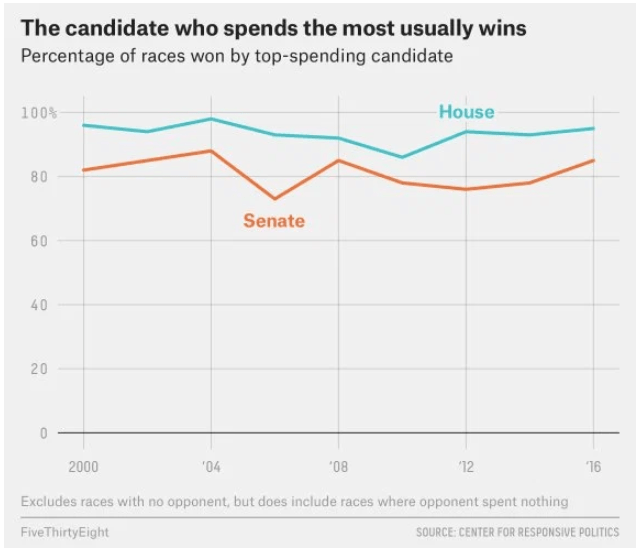
In the screenshot above from FiveThirtyEight, we can infer that in general elections, those who spend more money from funding tend to win elections more often. In the House of Representatives alone 90% of the House candidates who exhaust the money end up winning the election and in a 6-year time span, there was only one deviation. However, money doesn’t always guarantee that candidates will win, it just means that they are more likely to win since they have more money to campaign and advertise themselves. But it also is very important to realize that advertisements aren’t the end-all in deciding who wins an election, “In 2016, about 7 in 10 voters identified as either a Democrat or Republican, according to exit polls; 89 percent of Democrats voted for Clinton and 90 percent of Republicans voted for Trump” (FiveThirtyEight). Campaigning is important for a candidate’s success, but most voters aren’t very persuadable and will still vote for their political party regardless.
In brief, essentially all that I’ve talked about in my past blog posts ties together here for elections. The group that has the most prominent influence on elections are political parties, with the media as a great power in forming impressions on the candidates in the political parties. When it comes to the public deciding who to vote for, they will likely still continue to vote for candidates in their political party. This is due to the American public’s ideological views being skewed to their side of the spectrum and being against other views, People will not support and vote for a candidate from a party that isn’t theirs. There is a chance that they would, but when it comes to political polarization and confirmation bias’, I deeply distrust that people will shift their political party’s beliefs.
In this blog post we will be analyzing some data about the media in regards to political biases.
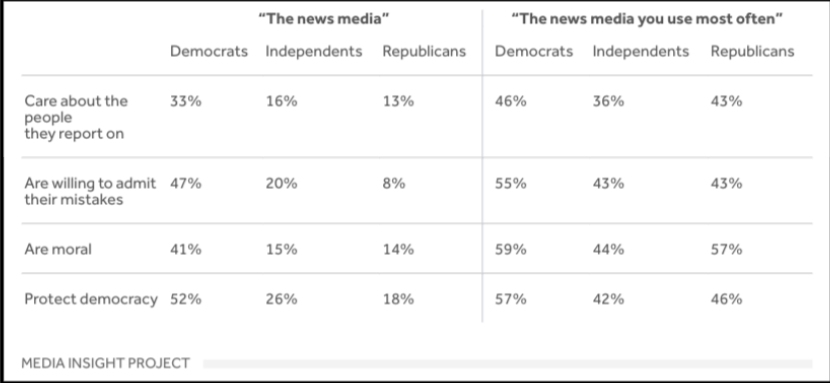
First we can see on the left side shows “The News Media” and how they rank on an individual scale as independent news outlets, whereas the right side shows the rating of how citizens rank their news/media sources and how they feel they should be on the scale.
The first, trend we will be acknowledging pertains to the Democrats on both sides of the graph, we can see that in both “The news media” and “The news media you use most often” the Democrats remain the highest percent in all questions. We can specifically see this when the chart shows us regarding the question of whether or not the party is moral we can see that the Democrats went from 41% to 59% which is almost an 11% increase which is pretty significant.
Another, Trend that stands out is that on the right side whose demographic is about “The news media you use most often” illustrates that every Political Party on the graphs percentages are seen skyrocketing we can most closely see then when the graph states the republicans had 14% on the question of are they moral they jump to 57% which is a 43% increase which is a extremely drastic change for originally being so low
In today’s Blog Post we will be discussing Interest Groups
Analysing bias’ in the Media
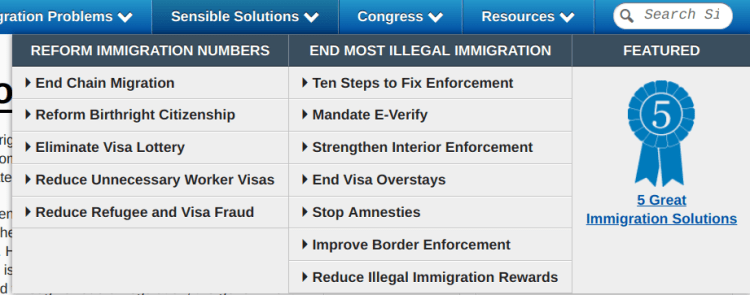
In today’s blog post we are going to be analyzing the different biases within the Interest Group “NumbersUSA” who in the image below market themselves as a “Immigrant-Reduction Organization”. According to the Pew Research Center this Interest Group aligns almost perfectly with the right leaning “Country First Conservatives”, which states that a Country First Conservatives are “Are unhappy with the nation’s course, highly critical of immigrants and deeply wary of U.S. global involvement. I believe it is safe to say that this interest is among a far right conservative interest group, particularly when they state at the bottom of their website that they ” Favor reductions in immigration numbers toward traditional levels ” This helps the reader immediately understand the organizations purpose.
This interest group main goal is “immigrant-reduction”
This image says a lot about the organizations way of conducting business and their essential goal of immigrant-reduction. They claim that there are “Sensible Solutions” to reduce and or end illegal immigration through way of both reform immigration numbers and end most illegal immigration. One of the ways they plan to reform immigration numbers is to Reform Birthright Citizenship where they try and use scare tactics regarding terrorist and 9/11 which is appealing to the older white people. They use a bias surrounding superiority and they try and market as them educating other people for all backgrounds, but they simply aren’t putting people’s best interest first. It isn’t hard to find this information on their website especially when they label themselves as “An Immigrant-reduction group” which should help us see their true colors and their true intentions. To continue, about reforming birthright citizenship which would mean they would be taking so many opportunities and sensible ideas away Birthright citizenship is according to The History Channel “In the U.S., children obtain their citizenship at birth through the legal principle of jus soli (“right of the soil”)—that is, being born on U.S. soil—or jus sanguinis (“right of blood”)—that is, being born to parents who are United States citizens.” which means while although some of the people that migrated to the U.S. may not have come here without without proper citizenship or any other circumstance their child would be denied citizenship if born here seems very extreme and it would take a lot of people to truly enforce that rule which seems unrealistic in any sense.



 Deconstructing Politics in America