From my standpoint, one of the most impactful factions that impact elections is political parties. Political parties have a huge influence on the American public’s views because many Americans are affiliated with one of the two major political parties, and these simple party loyalties affect their actions in terms of voting. Americans view politics through the views of their party, and that ends up having a tremendous impact on the decisions of people if they vote.
In my belief, the most consequential impression on national elections in America is due to political parties. Especially with the political polarization of the American people today. Political parties have been the basis for the divide in beliefs and ideology across all of America. Political parties hold a huge influence on the beliefs of the American public since “most voters identify with one of the two major political parties, and these basic partisan loyalties influence their behavior” (ICPSR, University of Michigan). Americans view politics through their party’s views and this ends up heavily Altering people’s decisions when voting.

As people continue to become more ideologically polarized, their decisions in voting will continue to skew farther and farther to the far left or the far right. As seen in the chart above from 270ToWin throughout 2016 Elections, we can clearly see the polarization effect that is occurring. Republicans tend to sit more on the right of the political spectrum and Democrats sit more on the left. As the country continues to become more polarized, the number of votes for Democrats and Republicans will increase. Another impact at hand here is that the Democratic and Republican parties gain much more funding for their campaigns than a third-party. The FEC makes two important notes about funding, “Public funding for major-party presidential nominees in the general election takes the form of a grant of $20 million-plus the COLA” and “The amount of public funding to which a minor party candidate is entitled is based on the ratio of the party’s popular vote in the preceding presidential election to the average popular vote of the two major-party candidates in that election.” These notes are extremely important since it literally just says that the major parties, Democratic and Republicans, gain more funding since the government already knows about them while the smaller third-parties have to go and prove to the government that they are big enough to earn any funding whatsoever. In accordance with the chart above, it makes sense why Clinton and Trump ended with such a dramatic in votes when compared to the other candidates. They were the ones who got the most funding after all.
The aforementioned chart from 270ToWin also represents another key idea that was mentioned over 50 years ago in James Madison’s Federalist Paper No. 10. This idea is called the Majority vs. Minority rule. As can be seen in the chart, Clinton won the popular vote by the majority but Trump ended up winning the election because of the electoral votes, even though his popular votes were the minority. This exemplifies Madison’s Majority vs. Minority rule in which he had predicted that the country would be divided into factions (political parties) and that there could be a point in which the majority of the country would support a specific party and the minority would be overwhelmed. With Federalist Paper No. 10, the minority still have the same chances of winning the election and the 2016 Elections clearly show that with Trump being the minority and winning while Clinton being the majority and losing. The issue here is what happens once the country becomes drastically polarized and the majority always wins. As the country becomes more polarized, the Democratic party, who are more liberally centered, and the Republic party, who are more conservatively centered, may actually start to fade out. Since people are heading more towards the far-left and the far-right on the political spectrum, they might actually start following third-party political parties such as further left Libertarian party and further right Constitution Party. This means that future elections could be completely different due to the American public supporting parties that aren’t the Democratic party and Republican party.

Fortunately, Madison’s foresight of political parties proceeds to be correct. Within the image above from Federalist Paper No. 10, Madison asserts that the conception of political parties can’t be avoided, nonetheless, the influences of those parties can be controlled. This suggests that there are ways for political parties to be regulated so that they don’t attain too much authority and influence in the country. But what are some of these methods of influence? To start, there’s the media for one.
The media is another unit of the groups that also have an impact on elections. however, as some have come to believe, I don’t feel that the media is the most impactful when compared to political parties. I feel that the media is here to furnish the public facts about the world and to provide reports on whatever the government is producing. The media has a sizeable influence over the public, due to the public ordinarily going to the media to find knowledge on the political realm. The media is such an authority that occasionally “some candidates can be literally left invisible because they can’t win enough interest from the media” (University of Oregon). I individually don’t know much about the current 2020 election going on, all I know is that Joe Biden is running, I know of the name Julian Castro, Bernie Sanders had a heart attack recently and is recovering quite smoothly, and Donald Trump whom is seemingly upset about the impeachment process that is going on. I browse the internet pretty much every day and I rarely ever see anything in the political world. The media is so prominent nowadays since some candidates could just be disregarded by the media and because of that, the public is so oblivious about them and when it’s finally time to vote, we don’t know of anyone but the major figures. The media concentrates on covering major figures in either the Democratic or Republican party, they center on the type of people that would give them tons of views and clicks just so that their media source could gain more notoriety. The media also works to produce negative views on candidates, the media can make-up stories or focus solely on the weaknesses of the candidate. This gets even worse since media sources are dispersed all across the political spectrum and all these sources do is spit on the other political viewpoint. This causes the public to adjust more on the far-left or the far-right views instead of seeking for the middle ground that remains mostly unbiased.
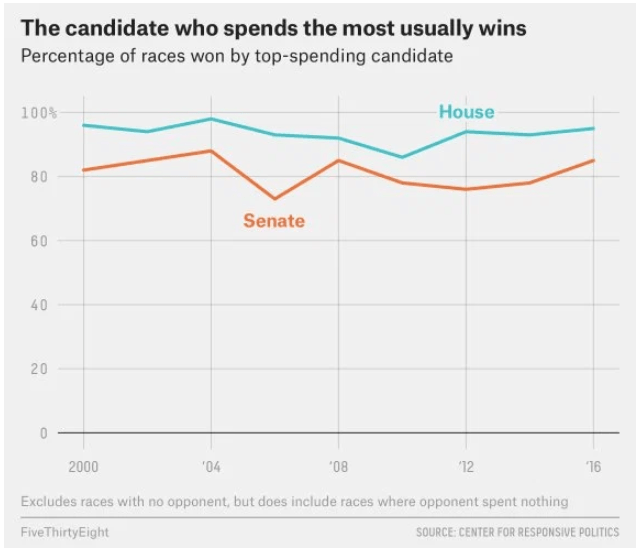
In the screenshot above from FiveThirtyEight, we can infer that in general elections, those who spend more money from funding tend to win elections more often. In the House of Representatives alone 90% of the House candidates who exhaust the money end up winning the election and in a 6-year time span, there was only one deviation. However, money doesn’t always guarantee that candidates will win, it just means that they are more likely to win since they have more money to campaign and advertise themselves. But it also is very important to realize that advertisements aren’t the end-all in deciding who wins an election, “In 2016, about 7 in 10 voters identified as either a Democrat or Republican, according to exit polls; 89 percent of Democrats voted for Clinton and 90 percent of Republicans voted for Trump” (FiveThirtyEight). Campaigning is important for a candidate’s success, but most voters aren’t very persuadable and will still vote for their political party regardless.
In brief, essentially all that I’ve talked about in my past blog posts ties together here for elections. The group that has the most prominent influence on elections are political parties, with the media as a great power in forming impressions on the candidates in the political parties. When it comes to the public deciding who to vote for, they will likely still continue to vote for candidates in their political party. This is due to the American public’s ideological views being skewed to their side of the spectrum and being against other views, People will not support and vote for a candidate from a party that isn’t theirs. There is a chance that they would, but when it comes to political polarization and confirmation bias’, I deeply distrust that people will shift their political party’s beliefs.
 Deconstructing Politics in America